ESTIMATED: 4 + MILLION DEAD
Introduction
Area: Bengal, Bharat (India)
Cause of Death: Starvation, Malaria, Other Diseases
Responsible: British Leadership, British Government, Provincial Government
Death Count: 4,000,000 +
Time Period: 1943
Dharmic Faiths: Hindus and Buddhists
In the Bengal Province in Western India there was a major famine in 1943 that is said to have took the lives of between 2 and 4 million people. What's worse is that the famine could have both been prevented and its effect not so severe had the British acted with integrity towards the people of India. A country that would later provide them with 2.5 million of its sons for the British war efforts as part of WW2.
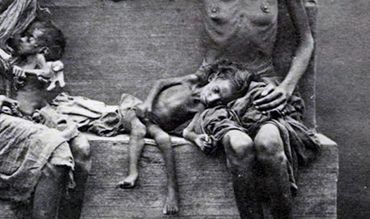
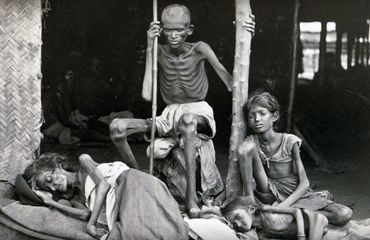
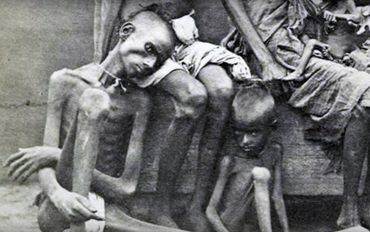
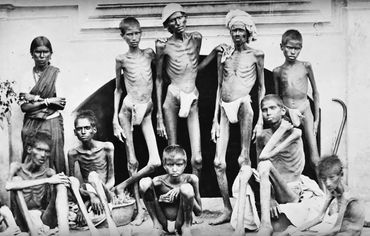
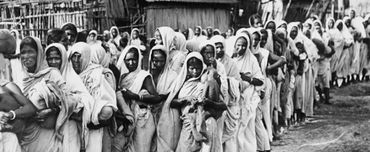
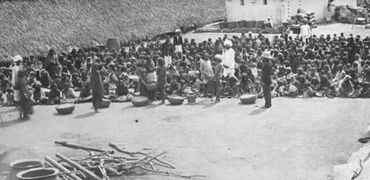
During the famine the people took to eating leaves and grass just to survive, the dead were piled up on the streets as the living didn't even have the energy to cremate them and many turned to suicide as the only way out. Of those that did manage to work at pitiful wages, many women were turned to prostitution simply in order to survive. The people largely died from starvation, malaria and other diseases caused by poor sanitation, large population migrations, malnutrition and lack of sufficient health care. Even historians consider the famine to be 'man made' and put its cause firmly in the hands of Winston Churchill.

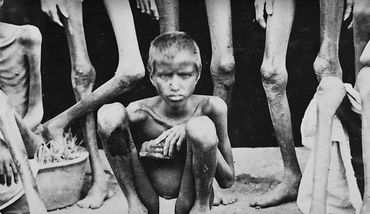
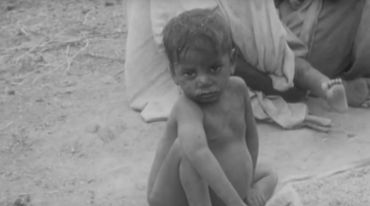
Emaciated, Starving Children - Victims of British Engineered Famines?
WHAT LED UP TO THE FAMINE?
Events Leading Up To The Famine
1942 - Japan Invades Burma, next door to the province of Bengal
1942 - British evict 180,000 Bengal Farmers for their war effort
1942 - British seize 125,000 acres of land for their military base
1942 - British seize all boats in Bengal and cut off vital shipping roots that bring in food via trade
1942 - British implement 'Scorched Earth' policy, burning rice fields, so that they 'don't end up in the hands of the Japanese
1942 - British still export 70,000 tonnes of rice from India, despite knowing about the forthcoming potential famine
1942 - British increase food stores in Britain, whilst depleting grain in Bengal
1942 - British actively discouraged inter-province trade, something which could have significantly reduced the death count

Survivors that looked like they belonged in concentration camps
RELIEF EFFORTS?
What was done to correct their mistakes?
It is well known that Winston Churchill had utter contempt for both India and Indians. He once called us: "A beastly people with a beastly religion", having such a man in charge of Britain really didn't help the situation. His nonchalant view toward Indians dying was clearly demonstrated when he said "Famine or no famine, Indians will breed like rabbits" and defended Indians being starved by stating that it was more important that the British feed the Greeks at the time.
During the famine, Sir Archibald Wavell and Leopold Amery (Secretary of State for India) made a request to the British Government for assistance but Winston Churchill refused. Viceroy Linlithgow then accused the Bengal traders of hoarding grain, a viewpoint then adopted by the British at the time. Churchill censored news and pictures in the British Press and banned a publication called 'Humanity Dehumanised', showing drawings of Bengal famine victims. Luckily a British paper 'The Statesman' disregarded the ban and sided with their good nature, once the public found out about the famine things started to change. Viceroy Linlithgow was then replaced with
Sir Archibald Wavell and Leopold Amery and the relief effort really began.
By the time the damage was already done Churchill requested 1 million tonnes of grain, but only delivered on 350,000 tonnes and a further 50,000 tonnes, requested from Eisenhower was never delivered. Luckily the harvest in Bengal in 1944 was enough to once again provide sustenance for it's people, but this entire event could have been avoided if the some of the British Leadership were not racist bigots.

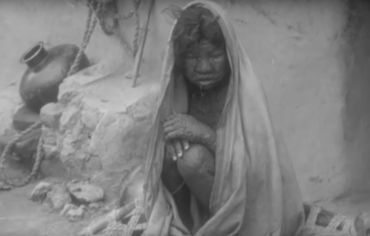
Elderly Victim, clinging to life!
Photo Gallery